
November 2026
Editor: Manasvee Saraf
Foreword
With the commencement of the 4MOST surveys, I am pleased to introduce the first WAVES newsletter. Published every three months, in alignment with the 4MOST data releases, the newsletter aims to keep WAVES team members informed about developments across the survey, while helping them identify opportunities to contribute, engage and collaborate.
In this inaugural issue, the PIs reflect on the journey that has brought us to this milestone and look ahead to what lies in store. We also recognise the contributions of key members of the collaboration, including our ECRs, and seek to establish an ECR network lead. The Year 1 science focus is outlined, alongside the introduction of the survey progress plot. PIs from ORCHIDSS, StePS and 4C3R2 provide brief overviews of their respective survey aims. The Programme Manager shares updates on the development of new tools and data products by the TWGs, celebrates the first RIP to pass quality control (QC), and highlights opportunities for team members to get involved in QC efforts. Alongside a highlight from SWG5 on the newly available SPV data, the Project Scientist outlines plans for increased SWG activity, highlights how science priorities will help shape data product development, and announces an upcoming refresh of SWG leadership. Finally, we share upcoming meetings and introduce the WAVES calendar.
PI Update
Simon Driver & Joe Liske
So finally, after almost 12 years of engagement, the 4MOST surveys will commence on November 26th 2026.
First and foremost, a massive thank you to the managers, designers, engineers, operations teams, and software teams who have brought us to this point. It has not been a smooth or easy journey, but the dedication, resilience, and effort invested from so many directions are evident, and they have ultimately got us here.
History
As we prepare to start WAVES, it is worth reflecting on how we arrived at this moment.
For me, it began with a chance meeting at the 2013 workshop Deconstructing Galaxies at ESO Headquarters in Santiago, Chile, organised by Dmitri Gadotti and Ruben Sanchez-Janssen. Roelof was looking for additional funding for 4MOST, while I was beginning to think about the post-GAMA landscape. As a result, Aaron, Roelof and I organised a Town Hall meeting in Australia in March 2014 to gauge interest and support.
That meeting eventually led to two ARC LIEF submissions, which funded the construction of AESOP and the formation of the 4MOST8. Six months later, I attended the 4MOST Preliminary Design Science Kickoff meeting at AIP in November 2014, representing WAVES as a proposed new survey, alongside the existing eight hemispheric surveys.
Initially there was concern that, as a non-hemispheric survey, WAVES would create scheduling imbalances. However, early simulations demonstrated that, with some accommodation, it was entirely feasible. In 2015, Joe transitioned from ESO to Hamburg and, as part of his establishment package, secured funding to pay for LRS-B, substantially bolstering the WAVES contribution. Shortly afterwards (2018) the Magellanic Cloud survey was added from AIP, followed by TIDES (2019) and, later (2022), the ESO community survey programmes.
Additional support from UWA, the Australian Government, and contributions from our partners in Tartu, PAS, Sussex, Durham, UCL, Manchester and RuG meant that WAVES ultimately contributed approximately A$10.5 million towards the development of 4MOST.
We should also acknowledge the enormous effort invested by WAVES team members over the past decade in preparing for survey operations. This includes exposure-time estimation, redshifting software, image-analysis pipelines, catalogue construction, star-galaxy separation, photometric redshifts, data uploads, data flows, validation systems, and catalogue vetting. There are far too many contributors to name individually, but I think it is fair to say that Luke, Aaron and Sabine have carried a particularly large share of the load and deserve special recognition.
Looking Ahead
We expect ~100,000 redshifts to be delivered every three months for the next five years. These data will be complemented by new deep-wide imaging from Rubin, as well as full or partial coverage observations from Euclid, Roman, ASKAP and eROSITA/eRASS6. By the end of the survey, WAVES will comprise millions of spectroscopic redshifts and 100s of millions of photometric measurements, together with photometric redshifts.
The scientific ambition is broad – all things extragalactic for the latter half of the age of the Universe. I guess our headline is to map the nearby Universe to an unprecedented level of detail and in doing so potentially open a new frontier in the study of fine-scale structure, where we might hope to connect the voids and filaments to the dark matter haloes and galaxies that lie within.
In numbers, WAVES is expected to deliver:
- 200 million galaxies within the 1150 square degree WAVES footprint
- 2.5 million spectroscopic redshifts:
- 1.7 million for oWAVES (photo-z restricted)
- 3,300 for STePS (with 30hr integrations)
- 0.7 million for 4C3R2 (SOM selected)
- 170,000 for ORCHIDSS (MeerKAT selected)
- 300,000 dark matter haloes
- 15,000 voids
- 5,000 filaments
- 175 team members
- 63 institutes
- 16 countries
- 5 continents
Perhaps most importantly, our goal is not just to conduct another redshift survey, but to build a true legacy resource for the global community with a focus on easy access, reliable science ready products and panchromatic coverage (x-ray to radio). With this in mind we hope that what we now build, over the next five years, will be the go-to resource for the analysis of all things extragalactic, and the launchpad for a myriad of follow-on surveys well into the 2040s.
ECR Community
Critical to the success of WAVES, like GAMA, is the generation of ECRs and students that ultimately represent the powerhouse of effort and ideas and where WAVES hopefully is a vehicle through which they can prosper in their careers. As within 4MOST in general, the WAVES Exec (Simon, Joe and Sabine) are committed to promoting and empowering our ECRs and the starting point for this is the ongoing search for a WAVES ECR lead: if you are interested please contact Joe or I.
Year One Program
Finally, the year one program is our attempt to provide a coherent dataset for early science papers and is centred on data collected as part of Ivan Bladry’s Euclid ILS program. If year one observations go well this should allow a full depth group catalogue to be constructed over roughly 30 square degrees with supporting deep Euclid data.
WAVES Survey Progress
Aaron Robotham & Luke Davies
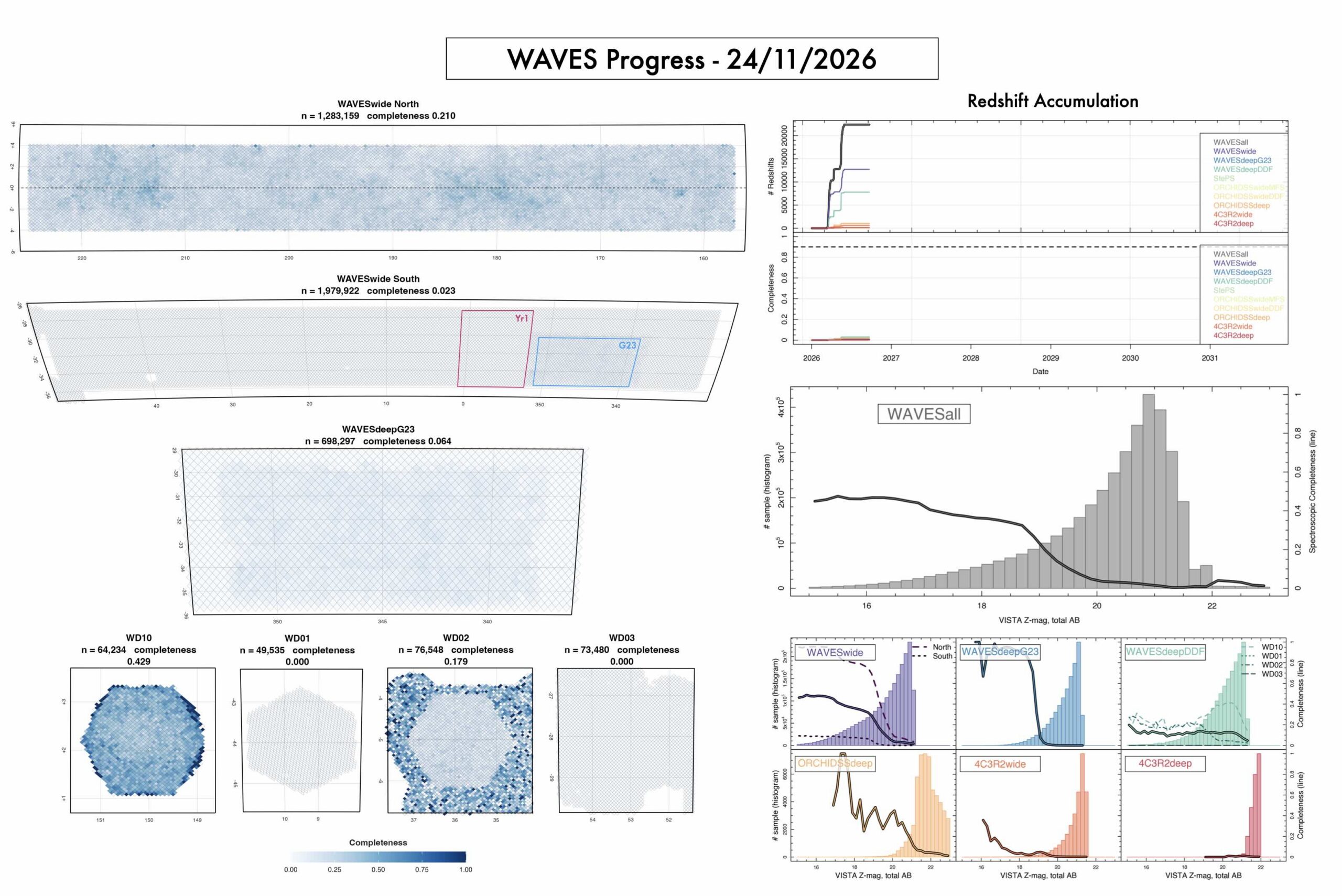
For the first year of operations WAVES will be prioritising a strip of WAVESwide South near 0 degrees right ascension (RA: 353 → 1 deg; Dec: -36 → -27 deg). This region is scientifically compelling because it overlaps with the accelerated Euclid fields that have been observed early in collaboration with WAVES (via Independent Legacy Scientist Ivan Baldry) and are large and contiguous enough to make group catalogues and environmental markers compelling. We will be highlighting the progress on this high-priority region distinctly as the survey progresses, so keep an eye out on the updates as they roll in.
The figure below summarises the progress of WAVES data collection, and will be updated with every subsequent newsletter.
ORCHIDSS
Kenneth Duncan
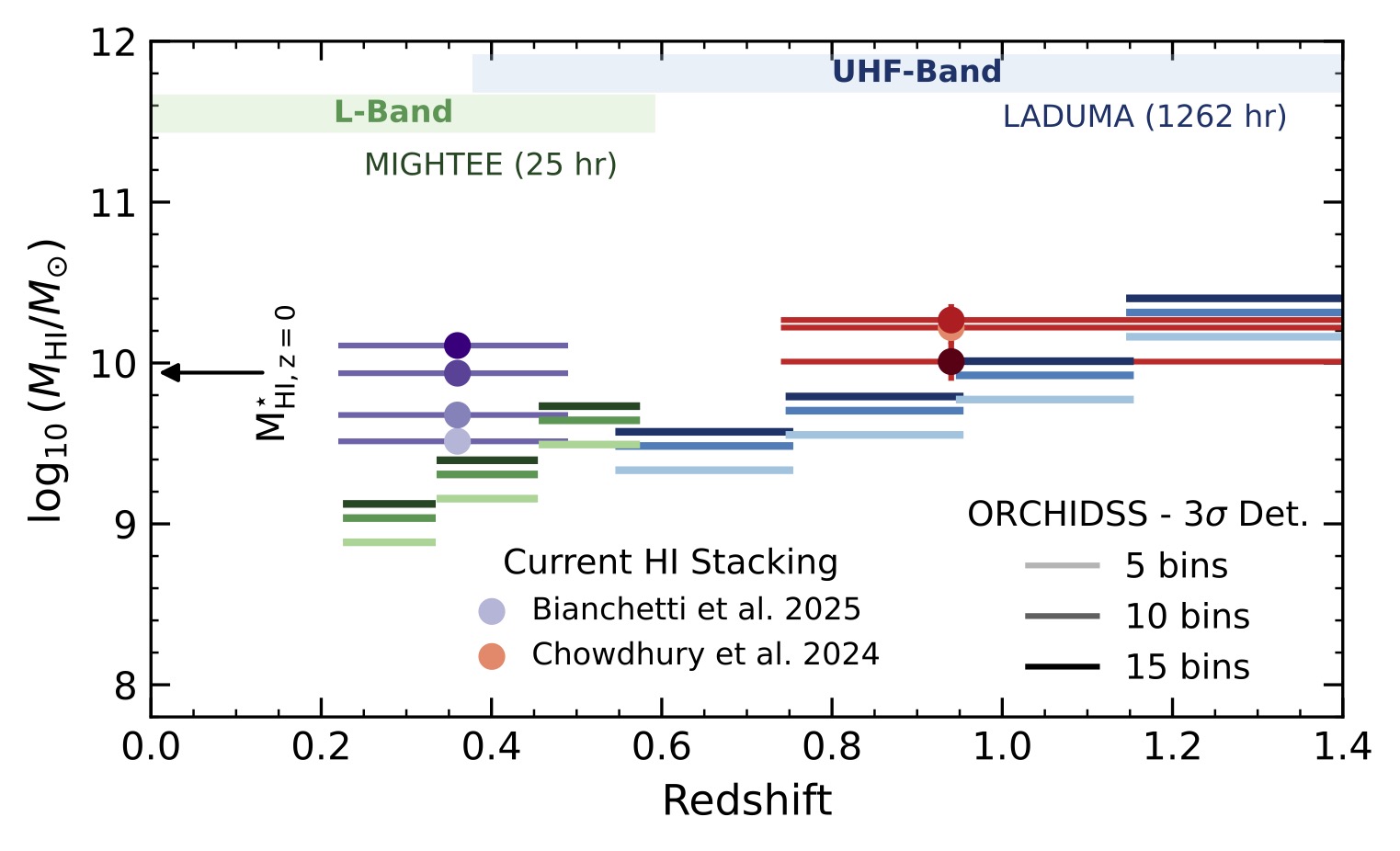
The core goal of ORCHIDSS is to provide the key spectroscopic resource required to maximise the scientific potential of MeerKAT’s deep extragalactic survey fields. By combining highly complete optical spectroscopy with deep radio continuum and HI observations, ORCHIDSS will enable a broad range of science. A key focus is enabling spectral stacking of HI in representative galaxy samples, probing far below MeerKAT’s noise thresholds to transform our understanding of neutral gas in galaxies out to higher redshifts. Read more here.
StePS
Angela Iovino & Marcella Longhetti
The 4MOST-StePS survey will collect high-quality spectra for ~3,300 galaxies at intermediate redshifts (0.3 < z < 0.7). Bridging the gap between LEGA-C and SDSS, it will trace galaxy evolution across the past 6-8 billion years. Thanks to this unprecedented data quality, the survey will characterize individual galaxies in detail – from their stellar populations and star formation histories to their internal kinematics and rejuvenation episodes – while also assessing environmental effects through synergy with WAVESdeep. Read more here.
4C3R2
Luca Tortorelli
The 4C3R2 survey aims to provide the extensive spectroscopic calibration needed to maximise the cosmological potential of future weak gravitational lensing experiments, including Euclid and the Vera C. Rubin Observatory. Using KiDS-VIKING optical and near-infrared photometry across the WAVES footprint, 4C3R2 will obtain spectra for more than 0.7 million galaxies, systematically sampling galaxy colour space to establish a robust colour-redshift relation. Unlike traditional spectroscopic surveys that prioritise completeness, 4C3R2 focuses on achieving representative and highly populated sampling across colour space, enabling accurate calibration of galaxy redshift distributions while minimising biases from spectroscopic incompleteness. This will provide a critical resource for precision cosmology and complementary redshift coverage alongside WAVES. Read more here.
Programme Manager’s Update
Sabine Bellstedt
With the start of 4MOST observations nigh, we’ve seen a ramping up of activity from the Technical Working Groups to provide a suite of useful data products for the WAVES team.
TWG7 has developed some fantastic tools (like valrip to help with RIP formatting, validation, and submission to QC), and has curated really detailed standards for data formats within WAVES. While the .parquet files we now use within WAVES might look a little different to the files you’re used to seeing, I am proud that we’re adopting modern formats with detailed metadata that will make it substantially easier to work with very large catalogues, and in the future allow us to work off remote data (rather than needing to download all files locally – watch this space!).
TWG6 is currently overseeing four separate data products in QC produced by TWG1 and TWG3 (interested individuals can follow along the QC fun on Gitlab), and the photometry catalogue (photometry_profound_base) was the first RIP to pass QC officially in July this year. Big thanks to those team members who have already made contributions to the QC process! If you’d like to get more involved (but haven’t had much to do with WAVES so far), then you’re a perfect candidate for QC – please reach out to Ivan Baldry to register your interest. The benefits of QC are not just gaining familiarity with data products and the capacity to shape how they look, but also an increased visibility within the team.
Are you starting to plan any science with WAVES data? Do consider signing up for the relevant TWG, and be part of the group that is curating the datasets that we use.
As of November, the WAVES Calendar will record the times and connection links for all TWG meetings so do subscribe, and feel free to join the conversation!
Project Scientist’s Update
Aaron Robotham
With the launch of the main WAVES survey on 4MOST we are hoping to see a steady ramp up in activity from our Science Working Groups (SWGs). I encourage all WAVES team members to find the SWGs that best overlap with their interests, and start getting busy. Posting ideas for projects, links to relevant papers, notifications of conferences etc – all of that is very welcome in the relevant Mattermost SWG channels.
The cadence of actual team data updates will not be more frequent than quarterly (3-months). What gets updated when is then really the purview of the relevant TWG, but it is always driven by the science ultimately. The more we can see exciting papers waiting on data product X, the more likely it is that data product X will be prioritised (human and computer resources are limited after all). SWG meetings will also pick up their cadence, since more will be going on. My hope is nearly all SWGs will start meeting at least quarterly, and this will ramp up to a monthly cadence as the survey matures.
Early next year we will invite a re-fresh of SWG leads (although people are welcome to re-apply of course). We hope most SWG leads are motivated to re-apply, but we also encourage other WAVES team members to consider applying.
I hope you are all as excited as I/we are to start doing real science with WAVES. It has been a long (15 year!) journey to get here, and I know that can sap even the most enthusiastic people of energy. But this is also when things will start getting fun. We are really striving to be an inclusive and friendly project to work within, and I can assure everyone that we are all aiming for the same thing: scientific discovery.
SWG 5: Spectral Analysis
Marcella Longhetti & Mirko Curti
The group’s activities are only now really getting underway, as the SPV data have finally become available. Their quality has also been assessed, and a new version addressing the issues identified is expected shortly. The aim of our recent meeting was to review what data are currently available and discuss the caveats that need to be taken into account when using them. The next meeting is planned for the end of January (date to be confirmed), with monthly meetings planned thereafter.
Upcoming Meetings and Events
| What | When | Where |
| 4MOST STM | 24-28 May 2027 | Perth, Australia |
| WAVES Team Meeting | 31 May-4 June 2027 | Perth, Australia |
| EAS 2027* | 21-25 June 2027 | Vienna, Austria |
The WAVES Calendar records the times and connection links for all internal WAVES meetings – subscribe to stay connected!